
Clinic management software for paediatric clinics
Curogrid is clinic management software for paediatricians and child specialists in India. Pick Paediatrics in clinic setup and it adds an Immunisation department, ten children's OPD services and 29 children's medicine names, mostly syrups and drops, offered as you type. Each child's file opens on a Growth card that draws the last five weights, with the latest height beside them.
Software for a paediatric clinic or child specialist in India
A children's clinic needs a weight at every visit, medicines written as syrups and drops, a parent who signs for the child, and vaccination visits that are billed. Curogrid's Paediatrics setup is built around those four things. Paediatric and pediatric are the same word in two spellings, and this is the same product under both.
As a pediatric EMR and pediatric OPD software it records each visit's vitals, complaint, examination, diagnosis, medicines, tests and advice, and keeps them in the child's file with every bill. It draws the child's own weight and height over time. It does not plot percentile curves, hold the vaccination schedule or work out a dose from the weight.
Guide: How to record growth and vaccination visits in a paediatric clinic| Made for | Paediatricians (pediatricians), child specialists and children's clinics |
|---|---|
| Setup to pick in Curogrid | “Paediatrics” |
| Departments added | Paediatrics, Immunisation |
| Starter services | 10, from ₹100 to ₹800. You change every price. |
| Medicine names offered | 29 of its own, ahead of the general list |
| Tests and scans, one tap on the visit | 5 |
| Procedures, one tap in a new order | 3 |
| Several visits booked together | “Book several visits”: 3 visits, a week apart |
| First card in the patient's file | “Growth” |
| Consent forms added | Examination and treatment plan, Procedure or operation |
| Price | Plus ₹399 a month, Pro ₹999 a month, for the whole clinic |
| Runs on | Web browser, Android, iPhone and Windows |
For a paediatric clinic
Three things Curogrid does for a paediatrician
- 01
Growth is the first thing you see
A child's file opens on a Growth card: the last five weights as a small chart, with the latest height beside it. You see whether the child is gaining before you read a single note.
- 02
Syrups and drops come first
The names offered first are the ones a paediatrician writes: paracetamol 120 mg/5 ml syrup, zinc syrup, vitamin D3 drops, salbutamol nebuliser solution. “Every 6 hours” and “By mouth with the dropper” are ready to pick beside the dose you type.
- 03
Babies go ahead in the line
The desk marks a token “Baby under 2”. Priority tokens are placed ahead of normal ones, and the tag shows beside the child's name in the doctor's line.
10 starter services and prices for a paediatric clinic
Pick “Paediatrics” in clinic setup and these services are in your price list before your first patient. Curogrid shows you the full list first and adds nothing until you press the button. The prices are starter prices for a small city practice. Change every one, rename what you call differently and delete what you do not offer.
- Departments added
- Paediatrics, Immunisation
- Consent forms added
- Examination and treatment plan, Procedure or operation
| Service | Starter price | Length |
|---|---|---|
| New consultation | ₹500 | 20 min |
| Follow-up consultation | ₹300 | 15 min |
| Newborn check | ₹700 | 30 min |
| Growth and development assessment | ₹600 | 30 min |
| Immunisation, visit charge | ₹200 | 15 min |
| Nebulisation | ₹250 | 20 min |
| Nutrition counselling | ₹500 | 30 min |
| Developmental screening | ₹800 | 45 min |
| School health certificate | ₹300 | 10 min |
| Weight and height check | ₹100 | 5 min |
On the doctor's screen
Medicines, tests and procedures offered to a paediatrician
Medicine names appear as you type. Tests and scans are one tap on the visit, and procedures are one tap in a new order. Curogrid offers the name only: the dose, and the decision, are always the doctor's.
Medicines (29)
Offered as you type, ahead of the general list. Any other medicine can still be typed in full.
- Paracetamol 120 mg/5 ml syrup
- Paracetamol drops 100 mg/ml
- Ibuprofen 100 mg/5 ml syrup
- Amoxicillin 250 mg/5 ml syrup
- Amoxicillin + Clavulanate 228.5 mg/5 ml syrup
- Cefixime 50 mg/5 ml syrup
- Cefpodoxime 50 mg/5 ml syrup
- Azithromycin 100 mg/5 ml syrup
- Cetirizine 5 mg/5 ml syrup
- Levocetirizine 2.5 mg/5 ml syrup
- Ondansetron 2 mg/5 ml syrup
- Domperidone 1 mg/ml suspension
- Zinc 20 mg/5 ml syrup
- ORS sachet
- Probiotic sachet
Show the other 14
- Salbutamol 2 mg/5 ml syrup
- Salbutamol nebuliser solution
- Budesonide nebuliser suspension
- Montelukast 4 mg chewable tablet
- Prednisolone 5 mg/5 ml syrup
- Albendazole 200 mg/5 ml suspension
- Lactulose syrup
- Simethicone drops
- Saline nasal drops
- Vitamin D3 400 IU drops
- Multivitamin drops
- Iron drops
- Calcium syrup
- Calamine lotion
Tests (5)
One tap on the visit. Ordered when the visit is finished.
- CBC with peripheral smear
- Urine culture
- Serum bilirubin
- Blood culture
- Mantoux test
Procedures (3)
One tap in a new order, under Procedure.
- Vaccination
- Nebulisation
- Growth check
Directions (5)
Ready to pick in the How often and How to take lists.
- Every 6 hours
- Every 8 hours
- Twice a day
- By mouth with the dropper
- In the nose
Diagnoses (19)
For a child specialist the list covers the chest and ear infections of early childhood, the fevers with a rash, newborn jaundice, poor weight gain and rickets, speech delay and bedwetting, and codes for a routine child health check and a vaccination visit.
- Acute upper respiratory infection
- Acute bronchiolitis
- Acute obstructive laryngitis (croup)
- Rotaviral enteritis
- Otitis media
- Acute tonsillitis
- Febrile convulsions
- Neonatal jaundice
- Enteroviral vesicular stomatitis with exanthem (hand, foot and mouth disease)
- Varicella without complication
- Measles without complication
- Mumps without complication
- Diaper (napkin) dermatitis
- Rickets, active
- Other lack of expected normal physiological development (poor weight gain)
Show the other 4
- Developmental disorder of speech and language (speech delay)
- Nonorganic enuresis (bedwetting)
- Routine child health examination
- Need for immunization against unspecified combinations of infectious diseases
The general OPD lists stay available after these names: 37 medicines, 22 tests and 9 scans, listed on the general practice page. The diagnoses above are 19 of the 365 in the ICD-10 list every Curogrid clinic searches by name or by code. A diagnosis that is not in the list is written in your own words. These lists are taken from the Curogrid app and were last checked on .
Step by step
A day in a paediatric clinic with Curogrid
Each step below is something the app does today. Nothing here is planned or coming.
1. At the desk
A baby goes ahead in the line
The receptionist gives a token and marks it “Baby under 2”. The token is placed ahead of normal ones, and the tag shows beside the child's name in the doctor's line.
How tokens and the waiting line work2. Before the doctor
Weight and height first
The sister writes the child's weight, height and temperature before the doctor sees them. “Weight and height check” is also a starter service at ₹100, for a clinic that charges for it.
3. In the doctor's room
The Growth card, then the visit
The child's file opens on Growth: the last five weights as a small chart, with the latest height. On the visit screen, under the weight box, is the last weight and the day it was taken.
What is in a patient's file4. Writing the visit
Syrups, drops and the dose you write
Type the first letters and the children's forms are offered ahead of the adult tablets. You type the dose. “Every 6 hours”, “Every 8 hours”, “By mouth with the dropper” and “In the nose” are in the lists beside it.
5. A vaccination visit
The visit is billed, the vial is counted
“Vaccination” is ready as a procedure in a new order, and “Immunisation, visit charge” is on the price list at a starter ₹200. The vaccine is kept in Stock with its batch number and expiry date.
6. Before a procedure
A parent signs on the screen
The parent or guardian reads the consent form on the screen and signs with a finger. If the guardian's name is on the child's record, it is filled in as the person signing.
Booking visits in a paediatric clinic
Most paediatric clinic visits are single visits, so booking is one step. When a patient does need to come back several times, the “Book several visits” switch books 3 visits, a week apart, at the same time of day, and labels each one.
How appointments workThe patient’s file in a paediatric clinic
For a paediatric clinic, the file opens on a card titled “Growth”. It draws the last five weights as a small chart, with the latest height beside them. Below it is what the patient is on now. Allergies and long-term conditions stay at the very top of every file.
What is in a patient’s fileBefore you try it
What Curogrid does not do for a paediatric clinic
These are the things a paediatrician might expect and will not find. Better to read them here than to find out in your first week.
It does not draw growth percentile charts
Curogrid draws the child's own weight and height as lines over time and works out BMI when both are recorded. It does not plot WHO or IAP percentile curves and does not work out a z-score.
It has no vaccination schedule
Curogrid does not hold the immunisation schedule, work out which vaccine is due or print a vaccination card. You record what was given and ask the child back on the day you choose.
It does not work out a dose
The weight is recorded and shown on the visit. The dose is typed by the doctor. Curogrid has no dose calculator.
It does not print the school certificate
School health certificate is a service on the price list, so it can be billed. The certificate itself is written on your own letterhead.
It does not admit children
Beds, admissions, a NICU record and the discharge summary are not built. Curogrid is for the clinic and the OPD.
And the rest of the clinic
Everything else a clinic needs is already there
The paediatrics setup sits on top of the same four screens every Curogrid clinic uses.
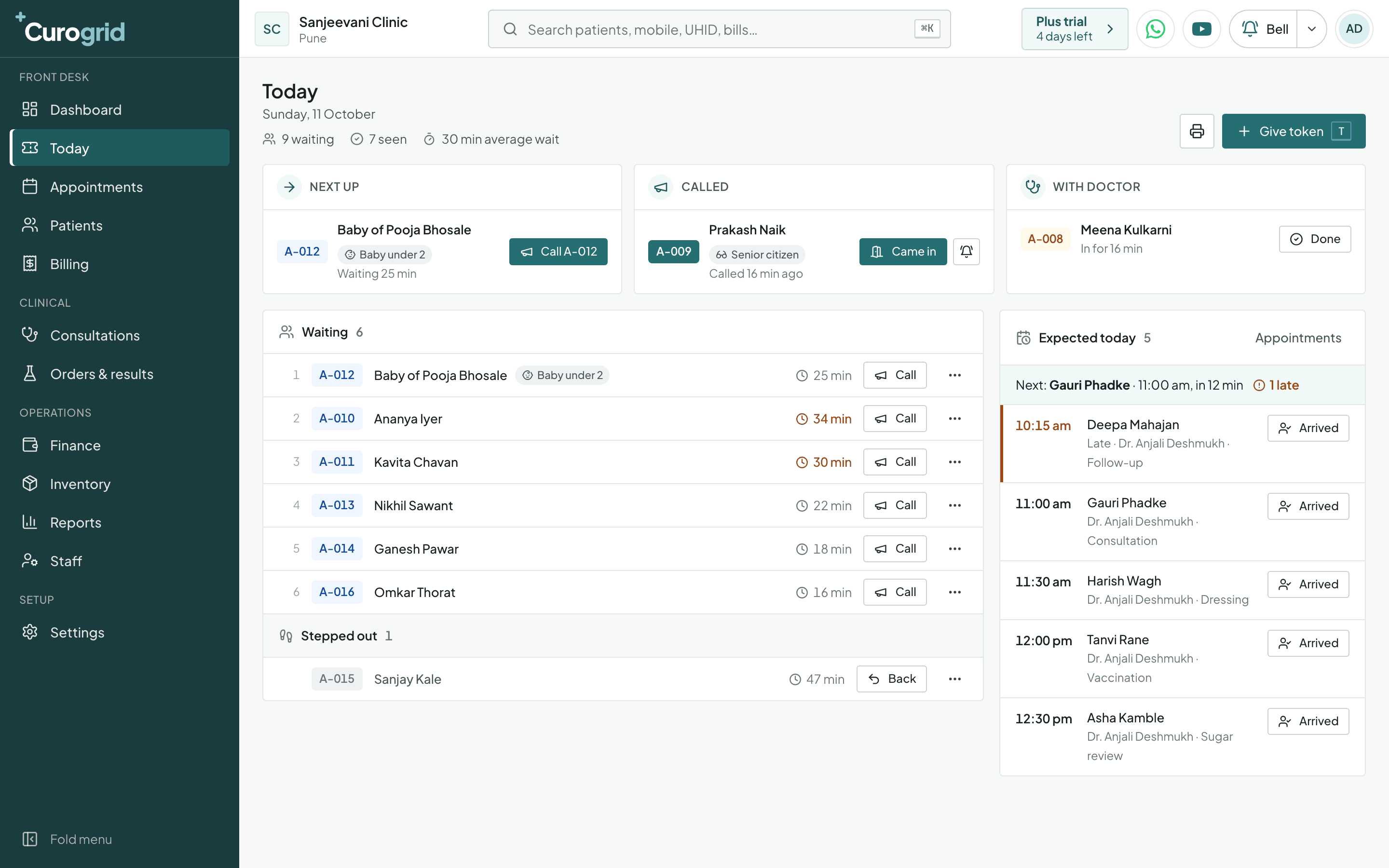
Tokens and the waiting line
A token for every walk-in, and a line the whole clinic can see.
Appointments
A column for each doctor, and a whole course booked at once.
Patient files
Allergies up top, then every visit, prescription, test and bill.
Billing
Today's money by UPI, cash and card, and a list of who owes.
The doctor and the staff also use Curogrid on the phone app for Android and iPhone.
What Curogrid costs a paediatric clinic
Plus is ₹399 a month and Pro is ₹999 a month, before GST, for the whole clinic. The paediatrics setup is included in both. Every clinic starts with 5 days of Pro, free.
Questions from paediatricians
Yes. Weight and height are saved at each visit. The child's file opens on a Growth card that draws the last five weights and shows the latest height. A Readings tab draws weight and height as lines over every visit, with a table you can save as a spreadsheet.
No. Curogrid draws the child's own weight and height over time as plain lines. It does not plot percentile curves or work out a z-score, so a percentile still has to be read from your own chart.
The visit is billed as a service, “Immunisation, visit charge”, at a starter price of ₹200. The vaccine itself is kept in Stock, because it comes in batches and expires, so each vial has a batch number and an expiry date and the stock list warns you before it runs out or expires.
No. Curogrid does not hold the immunisation schedule and does not work out which vaccine is due. You record the vaccination visit, then ask the child back on a day you pick or book the next visit yourself.
Yes. Choosing Paediatrics adds 29 children's medicine names: syrups, drops, suspensions, sachets and nebuliser solutions. They are offered ahead of the general list. Curogrid offers the name only. The dose is always the doctor's to write.
No. The weight is recorded at the visit and shown beside the prescription. Curogrid has no dose calculator and never suggests a dose.
Yes. A token can be marked “Baby under 2” at the desk. It is placed ahead of normal tokens, and the tag shows beside the name in the doctor's line.
The parent or guardian. The form is read on the screen and signed with a finger, and the person signing is recorded as the patient, a parent or guardian, or a relative. The signed form is kept in the child's file under Consents.
It does that work for an OPD. Each visit records vitals, complaint, examination, diagnosis, medicines, tests and advice. The diagnosis search includes croup, bronchiolitis, febrile convulsions, neonatal jaundice and hand, foot and mouth disease by their everyday names.
You can bill it. School health certificate is one of the ten starter services, at a starter price of ₹300, which you can change. Curogrid does not print the certificate itself.
Curogrid Plus is ₹399 a month and Pro is ₹999 a month, or ₹3,830 and ₹9,590 for a year. GST of 18% is added. The price is for the whole clinic, not for each doctor, and the Paediatrics setup is included in both plans. Every clinic starts with 5 days of Pro, free.
Yes. Curogrid sends the patient a reminder before the appointment by WhatsApp and email, and can send the prescription, the bill and the receipt the same way. On Plus the WhatsApp messages go from the Curogrid number. On Pro they go from your clinic's own number.
Not yet. A patient's 14-digit ABHA number can be recorded on their file, where it is marked as not checked with ABDM. Curogrid does not yet verify an ABHA number, create one or share records through ABDM.
No. Curogrid needs an internet connection. The phone app tells you when it is offline and saves nothing until the connection is back, and on a computer a visit you are typing is kept on that computer until it can be saved. The screens are in English only.
Other specialities
More than one kind of doctor under one roof
Pick each setup your clinic needs. The medicine and test lists are joined, and the booking drawer asks which kind of visits to book.
- General practiceA busy OPD: tokens, quick prescriptions, blood pressure over time.Curogrid for general physicians
- GynaecologyAntenatal visits booked as a course, scans and tests in one tap.Curogrid for gynaecologists
- Skin and hairLaser and peel sessions as a course, skin medicines, photo consent.Curogrid for dermatologists
- ENTAudiometry and endoscopy as services, ear and nose directions ready to pick.Curogrid for ENT specialists
- PhysiotherapyA whole course of sessions booked at once, packages and home visits.Curogrid for physiotherapists
Compare all the specialitiesWhat “speciality-specific” clinic software means
Try Curogrid in your paediatric clinic
The trial is 5 days of the Pro plan. Pick your speciality, and the services, medicines and booking are set up before your first patient.