
For ophthalmologists and eye clinics
Curogrid Eye: software for eye clinics
Both eyes on one screen, high pressure flagged, glasses prescriptions printed in a tap.
From ₹420 a month for the whole clinic. 5 days free.
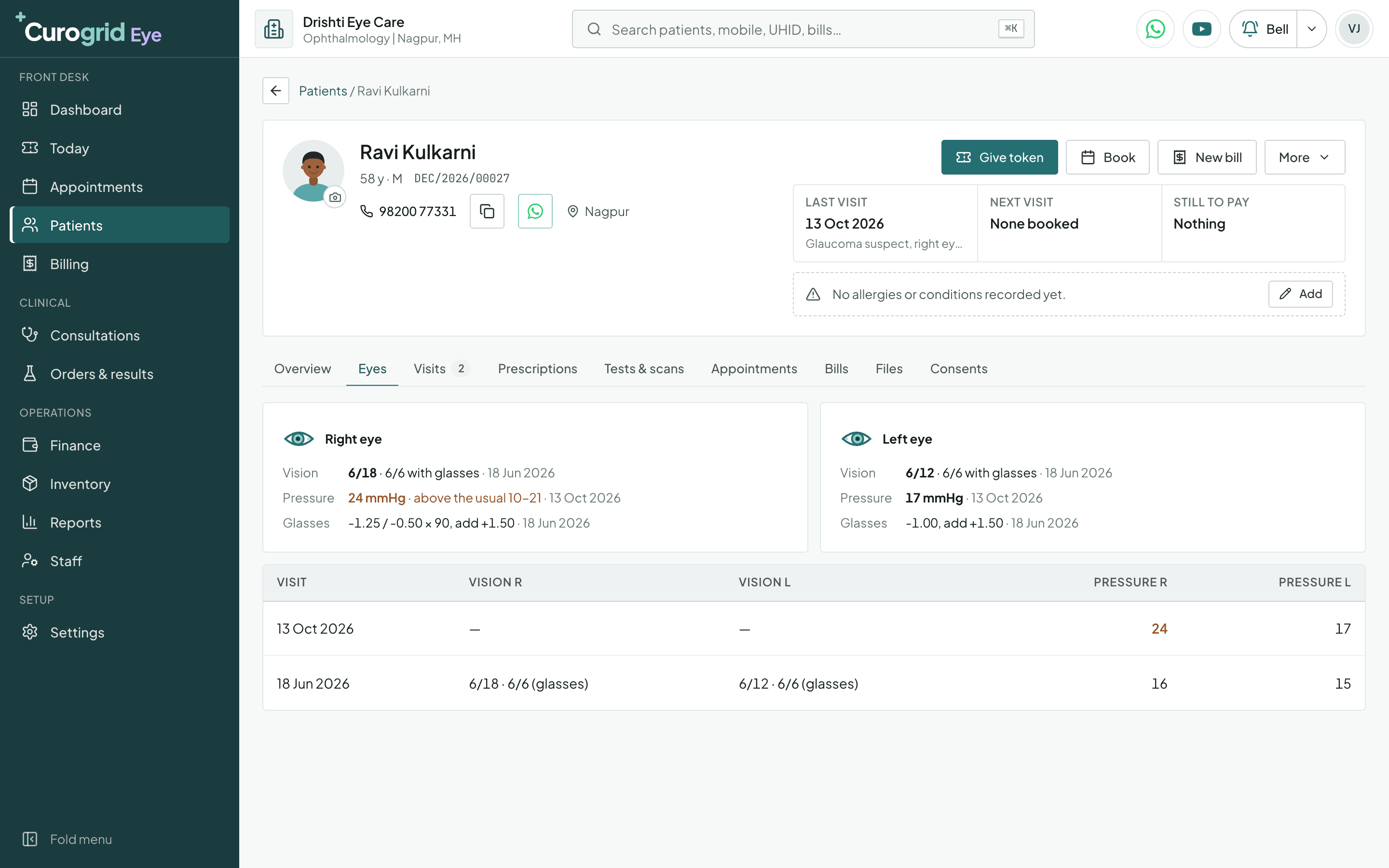
Each eye
Both eyes on one screen, and a high pressure you cannot miss
An eye patient's file opens an Eyes tab with a card for each eye: its latest vision, its pressure and its glasses. Below is every visit's readings for both eyes, newest first.
- Both eyes on one screen
- A high eye pressure you cannot miss
- Every visit's vision and pressure, newest first
See everything it records
What the Eyes tab shows
- Vision
- Unaided and with glasses, with the date it was taken: “6/18, 6/6 with glasses”.
- Pressure
- In mmHg, flagged when it is above the usual 10 to 21: “24 mmHg, above the usual 10 to 21”.
- Glasses
- The latest power: “−1.25 / −0.50 × 90, add +1.50”.
- Every visit
- Vision and pressure for the right and left eye, visit by visit.
The phone app shows the same Eyes tab.
On the doctor's screen
An eye examination in two columns, right and left
The first visit is laid out the way an ophthalmologist writes it, each eye in its own column. A review, or a check after surgery, is the short form.
- The examination laid out right eye, left eye
- Refraction and pressure entered by your optometrist
- Quick reviews after surgery
See everything it records
The first visit: Eyes
- Problem
- Blurred far or near, red eye, watering, itching, pain, floaters, glare, injury.
- Vision
- Unaided, with glasses, pinhole and near, for each eye.
- Glasses
- Sphere, cylinder, axis and add, for each eye.
- Eye pressure
- IOP in mmHg, for each eye.
- Front of the eye
- Lids, conjunctiva, cornea, anterior chamber, pupil and lens, for each eye.
- Retina
- Disc, macula and vessels, for each eye.
- Plan
- Glasses, drops, cataract surgery advised, YAG laser, review.
A review, or after surgery
- After surgery
- Day 1, day 7, day 30, or not after surgery.
- Vision
- Unaided and pinhole, for each eye.
- Eye pressure
- IOP for each eye.
- Front of the eye
- Ready words such as “Quiet eye” and “Cornea clear”.
- Notes
- Ready words such as “Drops explained” and “Wear the shield at night”.
Cataract surgery
The checks after cataract surgery, and the glasses at the end
Start the after-cataract plan on the day of surgery and Curogrid dates each check. The patient's file shows the next one, and the dashboard lists who is due this week.
- Day 1, week 1 and week 4 checks, never missed
- The glasses prescription printed at the last check
- Patients due for a check, listed for your desk
See everything it records
The three checks of the plan
- Day 1
- Eye check, start drops
- 1 week
- Check, taper drops
- 4 weeks
- Final check, glasses prescription
The glasses prescription
Print it from the visit on your letterhead: sphere, cylinder, axis and add for each eye, with the vision, signed with your name and registration number.
The whole clinic
Front desk, money and team, in one place
Tokens, appointments, bills, staff and the day's takings, on the computer and the phone.
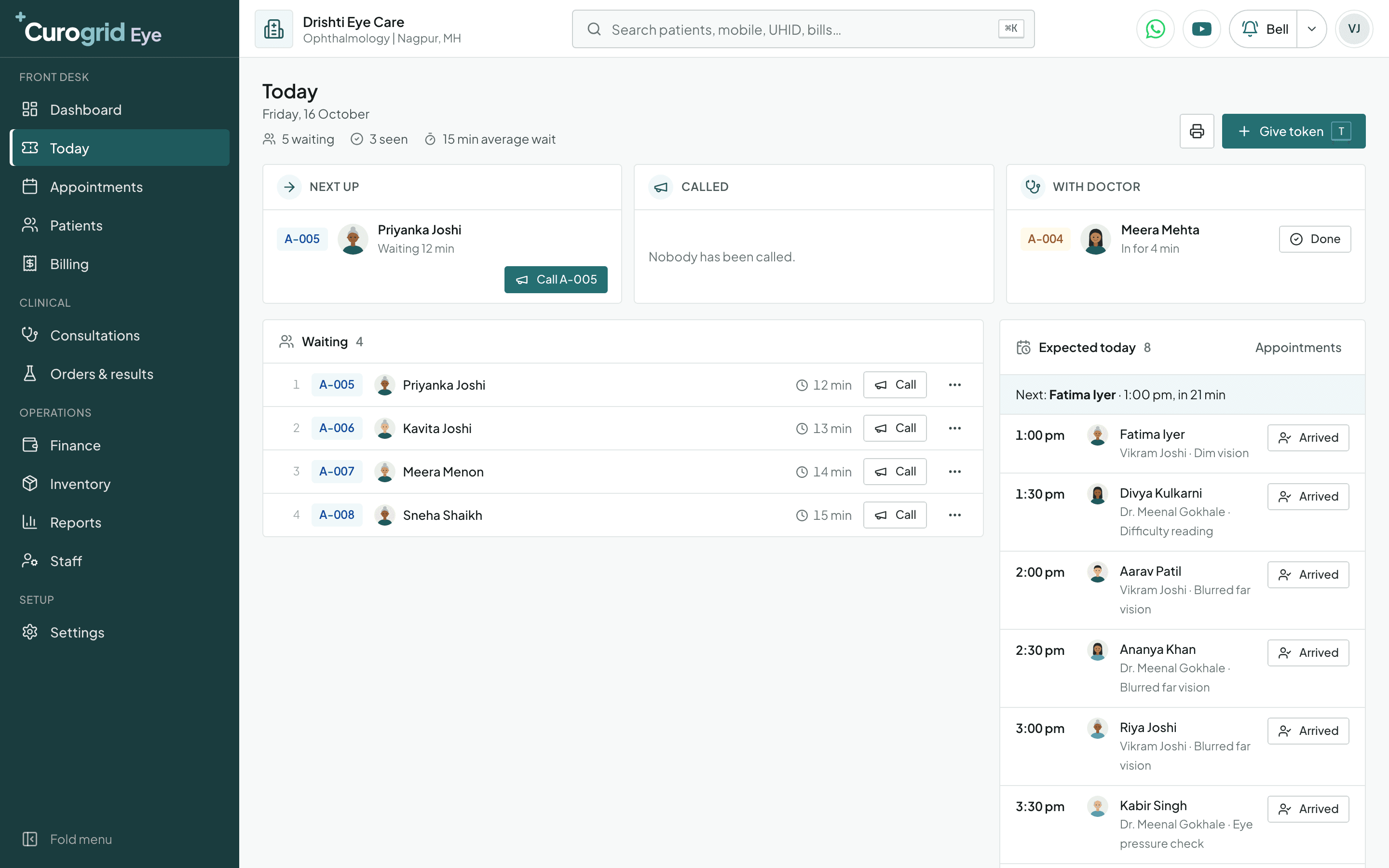
Today's line 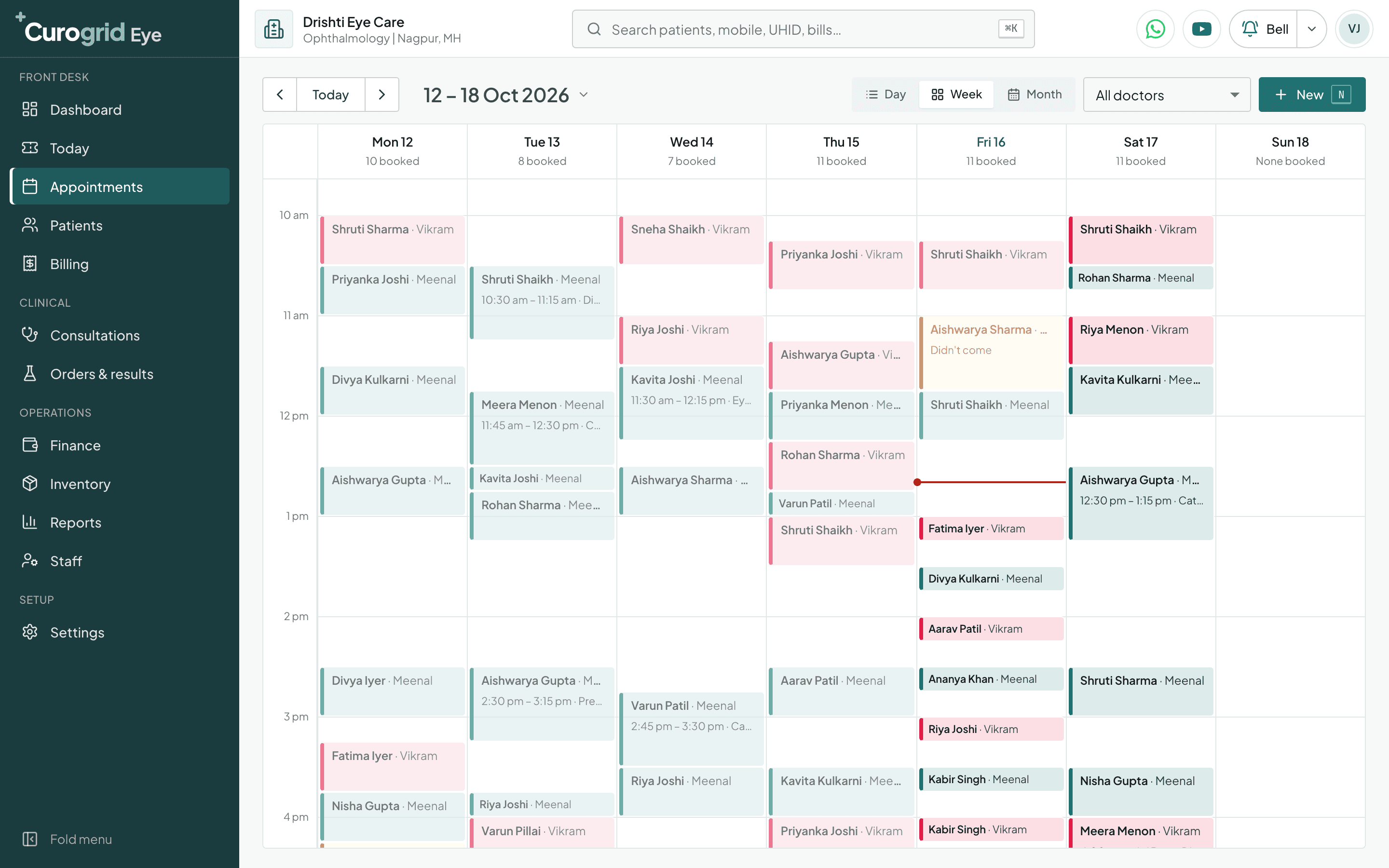
The appointment book 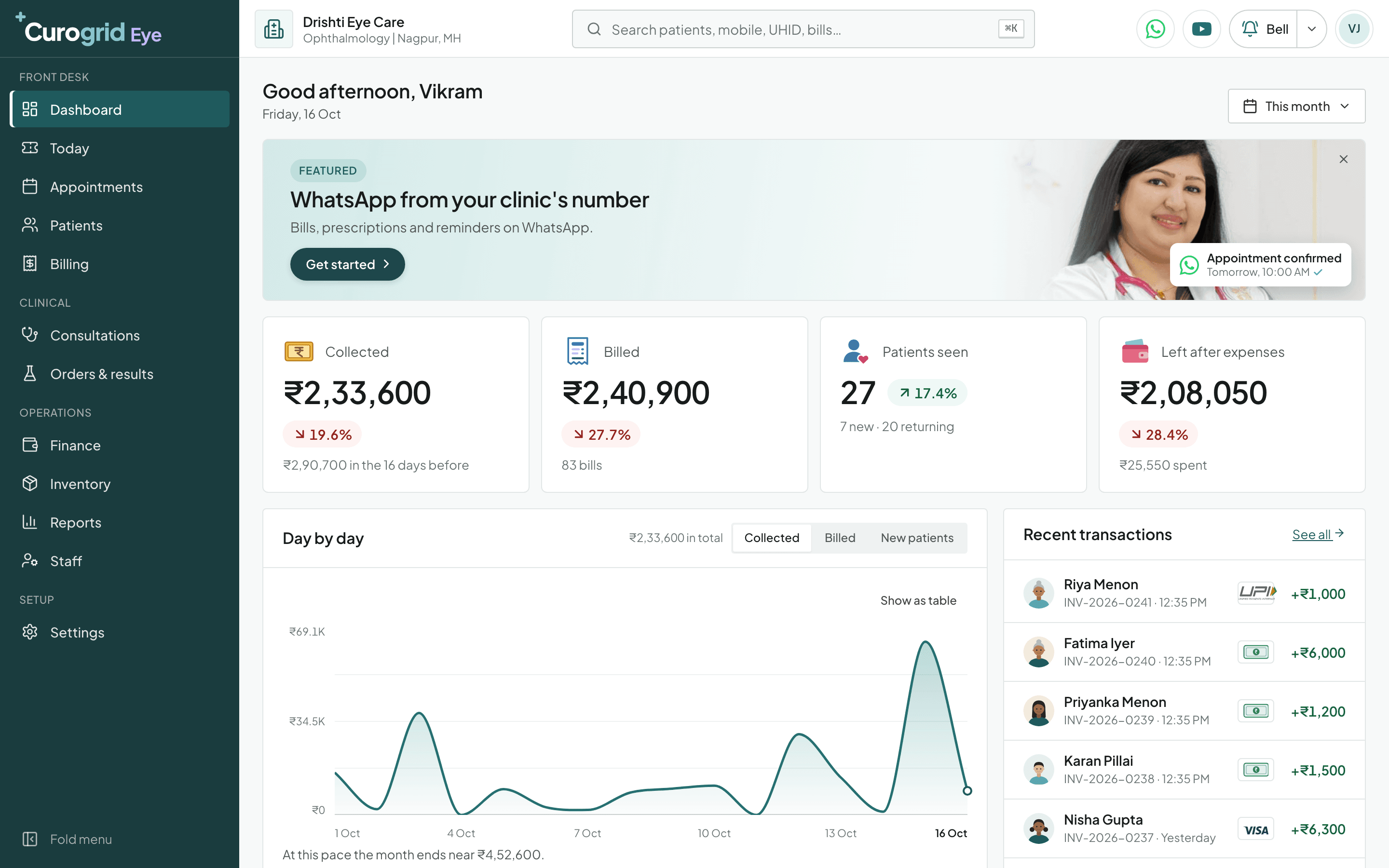
The owner's dashboard 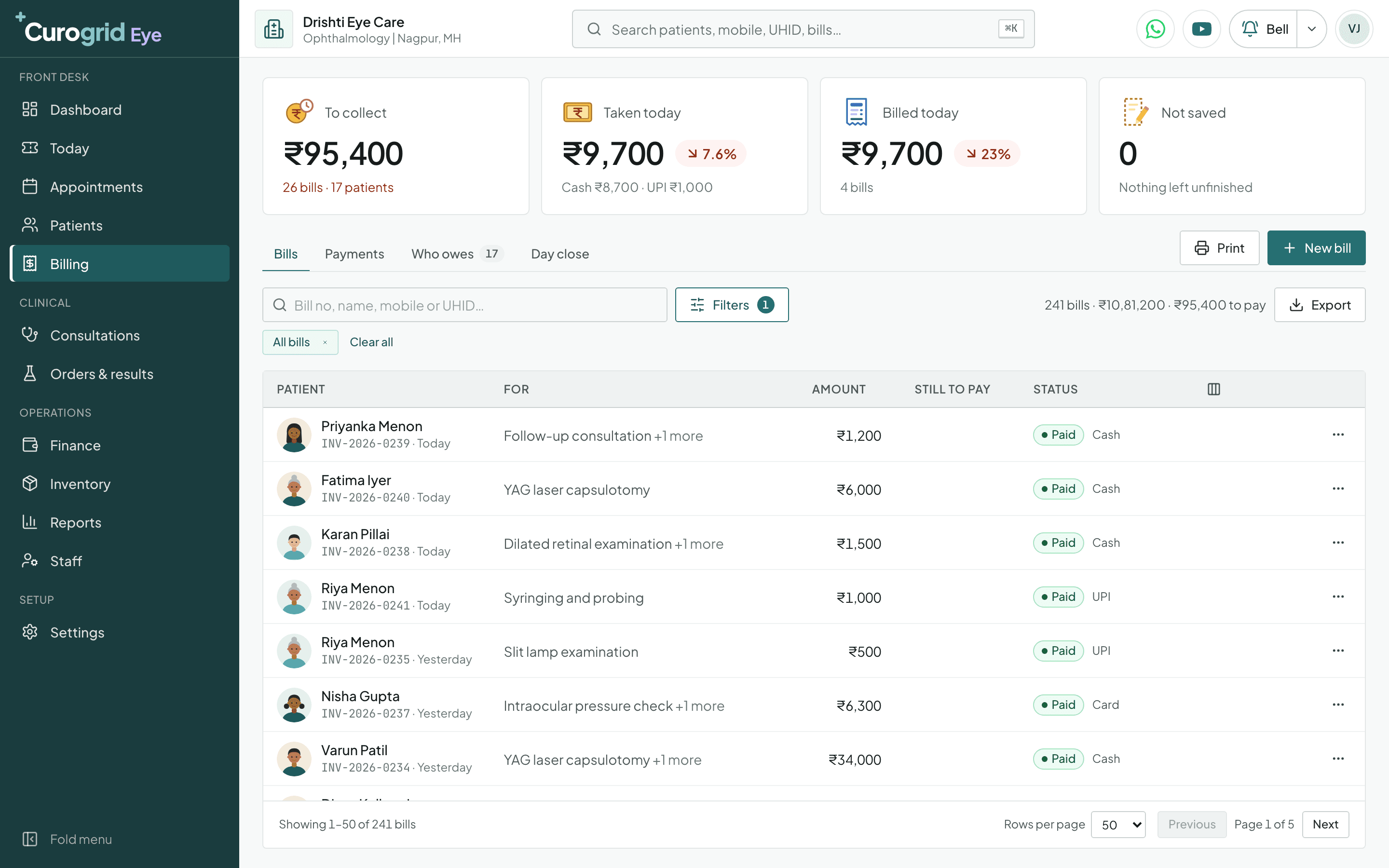
Billing by UPI, card and cash
An eye patient's way through the clinic, step by step
1. At the desk
A token, or the booked time. Walk-ins get a token; booked patients get a reminder before the visit on WhatsApp and by email. A patient over 60 can be given a priority token.
2. With the optometrist
Vision and refraction first. The optometrist records vision, the refraction and the eye pressure for each eye on the visit, before the doctor sees the patient.
3. With the doctor
The examination, eye by eye. The front of the eye and the retina in two columns, the plan, and the diagnosis, such as senile cataract or primary open-angle glaucoma, searched by name.
4. Drops
Drops with an eye and a time. The eye drops are offered first. “In the right eye” and “Every 2 hours” are ready to pick. If the patient is allergic to a medicine you write, a red warning says so.
5. Glasses
The prescription, printed. Print the glasses prescription for the optical shop of the patient's choice.
6. Cataract surgery
Consent, the bill and the plan. The patient signs “Procedure or operation” and “Local anaesthetic” on the screen. The surgery is billed from the price list, and the after-cataract plan starts from the day of surgery.
7. After surgery
Day 1, a week, a month. Each check is a short review with vision and pressure for each eye. At four weeks, the new glasses.
From ₹420 a month, for the whole clinic
Not per doctor. Everything on this page is included. Start with 5 days of Pro, free.
Questions from ophthalmologists
Yes. The eye visit has two columns, right and left: vision unaided, with glasses, with a pinhole and near; sphere, cylinder, axis and add; eye pressure; lids, conjunctiva, cornea, anterior chamber, pupil and lens; and disc, macula and vessels.
Yes. The patient's Eyes tab shows each eye's latest pressure and flags one above the usual 10 to 21 mmHg, on the eye's card and in the table of every visit's readings.
Yes. The glasses prescription prints from the visit on your letterhead: sphere, cylinder, axis and add for each eye, with the vision, your name and your registration number.
Yes. Start the after-cataract plan from the day of surgery and Curogrid lays out three checks: day 1 (eye check, start drops), 1 week (taper drops) and 4 weeks (final check and the glasses prescription). The review form records which day after surgery it is.
Yes. Optometry is set up as its own department, and each person has their own login. The optometrist can enter vision and refraction on the visit before the doctor sees the patient.
Yes. “Cataract surgery, phacoemulsification” and “YAG laser capsulotomy” are starter services, at starter prices of ₹28,000 and ₹6,000. Change them to your own fees.
24 eye medicines, from moxifloxacin and tobramycin to timolol, brimonidine, latanoprost, atropine and the tropicamide and phenylephrine drops for dilation. “In the right eye”, “In the left eye”, “In both eyes” and “Every 2 hours” are ready to pick.
Yes, for Android and iPhone. The doctor sees the line, writes the visit and opens a patient's Eyes tab on the phone. Curogrid also runs in a web browser and as a Windows app.
Curogrid Plus is ₹420 a month and Pro is ₹999 a month, or ₹4,032 and ₹9,590 for a year. GST of 18% is added. The price is for the whole clinic, not for each doctor, and the Ophthalmology setup is included in both plans. Every clinic starts with 5 days of Pro, free.
Yes. Curogrid sends the patient a reminder before the appointment by WhatsApp and email, and can send the prescription, the bill and the receipt the same way. On Plus the WhatsApp messages go from the Curogrid number. On Pro they go from your clinic's own number.
Not yet. A patient's 14-digit ABHA number can be recorded on their file, where it is marked as not checked with ABDM. Curogrid does not yet verify an ABHA number, create one or share records through ABDM.
No. Curogrid needs an internet connection. The phone app tells you when it is offline and saves nothing until the connection is back, and on a computer a visit you are typing is kept on that computer until it can be saved. The screens are in English only.
Good to know
Registrations and rules for an eye clinic in India, what Curogrid does not do, and the lists it offers. The rules are a plain summary, not legal advice, checked on .
Only a doctor on a State Medical Register or the Indian Medical Register may practise medicine, and the registration number belongs on every prescription, certificate and receipt you sign. The NMC's 2023 conduct regulations were put on hold in August 2023, so the 2002 code of ethics still applies. In Curogrid: Each doctor's qualifications, registration number and council are kept on their staff profile and print under their name on every prescription.
In the states and union territories that have adopted the Act, a clinic cannot run without registering with the district registering authority, and national minimum standards are set for each kind of clinic. Other states have their own registration law. Your district health office will say which applies. In Curogrid: Curogrid does not register your clinic. Your clinic's name, address and contact numbers print on every bill and paper it makes.
Optometry is one of the professions the Act recognises, and its registration regulations were published in September 2026: an optometrist may practise only after registering. State councils are still starting, so check what applies in your state. In Curogrid: Optometry is its own department, and the optometrist has their own sign-in and role.
Corneas are removed only by a doctor, after death is certified, with the consent of the next of kin, and only for a registered eye bank. Buying or selling them is a crime. A family can be pointed to the nearest eye bank through 1919. In Curogrid: Curogrid does not run an eye bank or keep a donor register.
A clinic that gives medicines to its own patients follows the drug rules. For Schedule H1 drugs, such as certain newer antibiotics and habit-forming medicines, each supply is written in a separate register with the prescriber, the patient, the medicine and the quantity, and the register is kept for three years. In Curogrid: When the medicine counter gives a medicine, it comes off the shelf count and goes on the patient's bill, so you can see who got what and when. Curogrid does not print a Schedule H1 register.
Explain what you will do, why, and its risks before you start, and keep the patient's agreement. For a child, a parent or guardian agrees. In Curogrid: The setup adds five consent forms: “Examination and treatment plan”, “Procedure or operation”, “Local anaesthetic”, “Sedation or general anaesthesia” and “Admission”. The patient, a parent or guardian, or a relative signs with a finger on the screen, and the form is kept in the patient's file.
Blades, needles and the drapes and swabs from surgery are bio-medical waste. Separate waste where it is made, put sharps in a puncture-proof white translucent container, hand it to your area's common bio-medical waste facility, and train the staff who handle it. In Curogrid: Curogrid does not manage waste. Each procedure is ordered and billed, so what was done and when is on record.
A patient's record is personal data, and the clinic is responsible for it. Tell patients what you keep and why, keep it safe, use it for their care, and let a patient see or correct what you hold. The Rules were notified in November 2025 and most of their duties for clinics apply from May 2027. In Curogrid: Every member of the team has their own sign-in and role, so the records show who did what, and nobody shares a password.
Health care by a clinical establishment or an authorised medical practitioner is exempt from GST: the diagnosis, treatment or care of an illness, injury or pregnancy. Anything sold or done outside that, such as a cosmetic product, may be taxed. Ask your chartered accountant what applies to your clinic. In Curogrid: A GST rate is set on a service only if you give it one, so taxable and exempt services can sit on the same bill. The clinic's GSTIN is needed only if you are registered.
The autorefractor, the tonometer, the OCT and the perimeter are not read by Curogrid. Readings are typed into the visit, and a scan's report is added to the patient's file as a PDF or a photo.
There is no diagram of the eye or the fundus to draw on. Findings are written in each eye's column, and a fundus photo is added as a file.
Cataract surgery is a service you book and bill, with its consents. A theatre list, the operation note, beds and the discharge summary are not built.
The glasses prescription prints, but frames, lenses and spectacle orders are not in Curogrid. An optical counter's sale can be typed onto a bill by hand.
A-scan biometry is ready to order, and its report goes in the file. Curogrid does not calculate the lens power.
Moxifloxacin 0.5% eye drops, Tobramycin 0.3% eye drops, Ciprofloxacin eye drops, Carboxymethylcellulose 0.5% eye drops, Lubricating eye gel, Olopatadine 0.1% eye drops, Sodium cromoglycate 2% eye drops, Prednisolone acetate 1% eye drops, Loteprednol 0.5% eye drops, Fluorometholone 0.1% eye drops, Nepafenac 0.1% eye drops, Ketorolac 0.5% eye drops, Timolol 0.5% eye drops, Brimonidine 0.2% eye drops, Dorzolamide 2% eye drops, Latanoprost 0.005% eye drops, Atropine 1% eye drops, Cyclopentolate 1% eye drops, Homatropine 2% eye drops, Tropicamide + Phenylephrine eye drops, Chloramphenicol eye ointment, Acyclovir 3% eye ointment, Natamycin 5% eye drops, Acetazolamide 250 mg tablet.
OCT (macula), Visual field (perimetry), Fundus photo, A-scan biometry, B-scan, Corneal topography.
Refraction, Eye pressure check, Dilated fundus examination, Syringing, Foreign body removal, Chalazion incision, YAG laser.
Senile cataract, Cataract, After-cataract (PCO), Primary open-angle glaucoma, Primary angle-closure glaucoma, Myopia, Hypermetropia (long sight), Astigmatism, Presbyopia, Mucopurulent conjunctivitis, Acute atopic conjunctivitis, Other disorders of lacrimal gland (dry eye), Pterygium, Chalazion, Hordeolum and other deep inflammation of eyelid, Corneal ulcer, Keratoconus, Iridocyclitis (uveitis), Degeneration of macula and posterior pole (macular degeneration, AMD), Retinal detachment with retinal break, Type 2 diabetes mellitus with ophthalmic complications (diabetic retinopathy), Strabismus (squint), Amblyopia ex anopsia (lazy eye), Other vitreous opacities (floaters).
Try Curogrid Eye in your clinic
5 days of Pro, free. Pick “Ophthalmology” in setup and the eye visit, the Eyes tab, the glasses prescription and your services are ready before your first patient.